⟵ back to the overview
Fairplan
What fairness in shift scheduling actually means
Why does a shift schedule feel unfair even when the hours are evenly distributed? For the Fairplan research project we ran eight interviews in a hospital setting — and turned them into two interfaces.
|
Reading time: 3 minutes
Starting point
For the people affected by it, hospital shift scheduling is largely a black box. Whoever is assigned to a weekend, a public holiday or a night shift rarely learns why the decision came out the way it did. On the planning side, the counterpart to this is a high degree of manual complexity: qualifications, absences, collectively agreed limits and individual requests all have to fit together at once. Fairness here is more than an even distribution of hours — it also grows out of how a decision is reached and how it is explained.
Project setting
Fairplan — in full, “FAIRPLAN – Fairness-optimized AI-supported resource planning in hospitals” — is a collaborative research project at the Chair of Materials Handling, Material Flow, Logistics (fml) at the Technical University of Munich. Its goal is to generate shift and operating theatre schedules with the help of AI, to make staff planning fairer and more efficient, to incorporate employee requests flexibly, and to make planning decisions transparent through explainable AI (XAI). The privacy-compliant, software-based demonstrator is being built in close cooperation with Klinikum rechts der Isar. Alongside proband15, the consortium comprises the TUM MITI research group, Emporias Management Consulting GmbH and software4production GmbH. The kick-off took place in early 2025.
Approach
proband15 contributes the human factors work. We conducted eight interviews with physicians and schedulers; one of them turned out not to be relevant to the research question and was dropped from the analysis. For the analysis we developed our own coding scheme, one that does not treat fairness as a single feeling but breaks it down into three dimensions: distributive justice (what is being distributed), procedural justice (how the decision is reached) and informational justice (how it is communicated). Seven codes make up this grid, with a further one capturing conflict scenarios. Two raters coded the material independently of each other. Three personas emerged from this, bundling the requirements of both roles.
Outcome
The coding turned into two UI concepts — one for the staff side, one for the planning side — and a clickable prototype with seven screens. It is JSON-data-driven and built in vanilla HTML, CSS and JavaScript without a framework; an A/B variant with an onboarding animation is part of it.
In the request interface, requests are prioritised on three levels — must, would like, if possible — instead of simply being set or not set. A request budget display makes visible how much weight is still available. This addresses the distributive dimension directly: once you can see what a request costs, you judge the result differently.
The staff side of the prototype: standing preferences (left) and the fairness statistics, which set your own share of unpopular shifts against the team average (right). All data shown is demo data; names have been obscured.
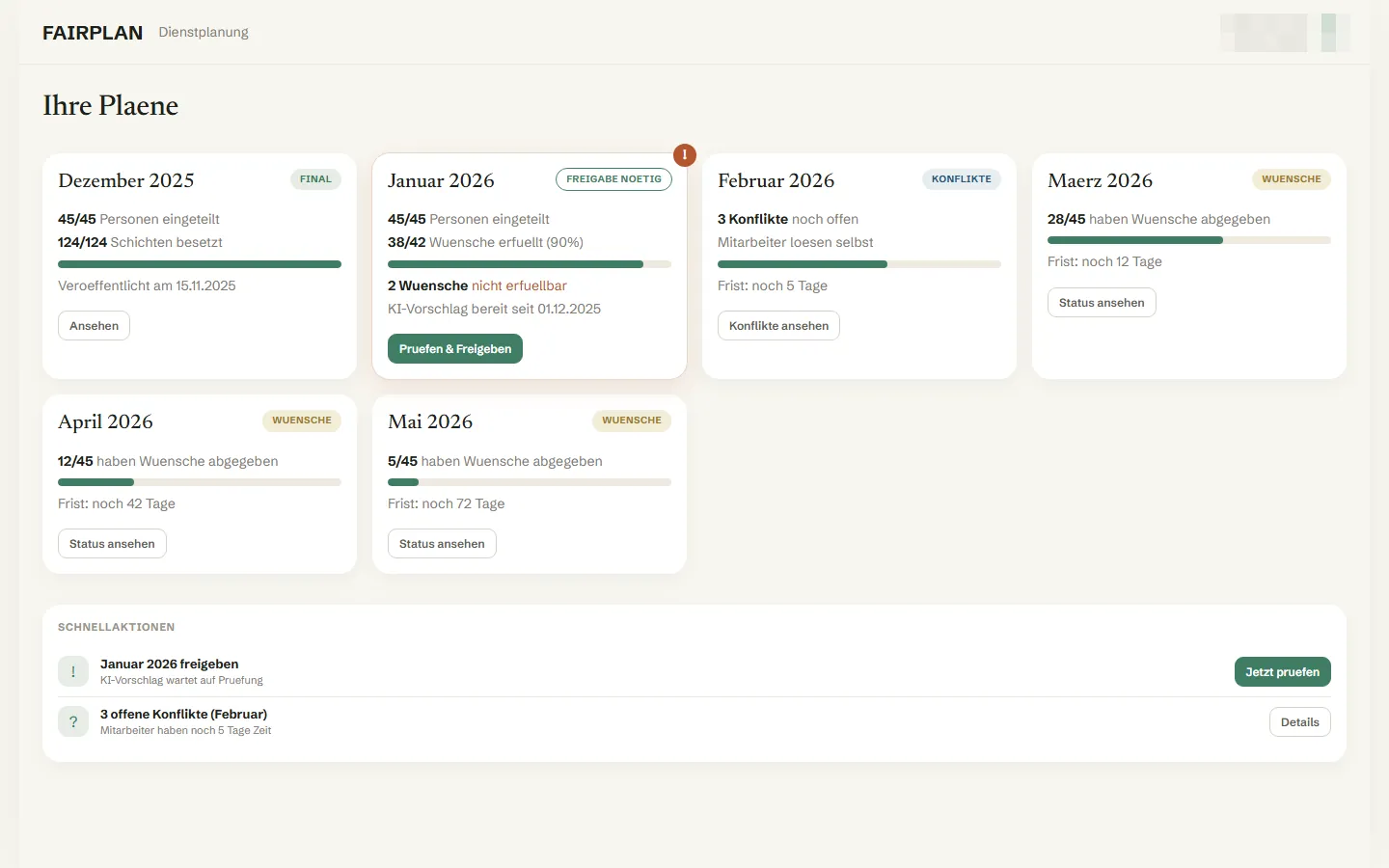
The scheduler interface colour-codes the calendar on a traffic-light principle and checks rules automatically, separated into hard and soft rules along the limits set by the Marburger Bund. The fairness statistics show how the unpopular shifts are spread across the team — the informational dimension, translated into an interface.
In numbers
The human factors contribution in numbers:
- 8 interviews, 7 of them in the analysis
- 3 dimensions of justice as the analytical grid
- 7 codes, coded by 2 raters
- 3 personas
- 2 UI concepts
- 1 clickable prototype with 7 screens
A similar question in your own organisation? Get in touch.
Fairplan is a research project carried out together with the Chair of Materials Handling, Material Flow, Logistics (fml) at the Technical University of Munich, the TUM MITI research group and Klinikum rechts der Isar, funded by the Bavarian Ministry of Economic Affairs, Regional Development and Energy under the Bavarian Collaborative Research Programme (BayVFP), Digitalisation funding line — grant number DIK-2408-0041, project management agency VDI/VDE Innovation + Technik GmbH. Duration 2025 to 2028.
⟵ more proband15